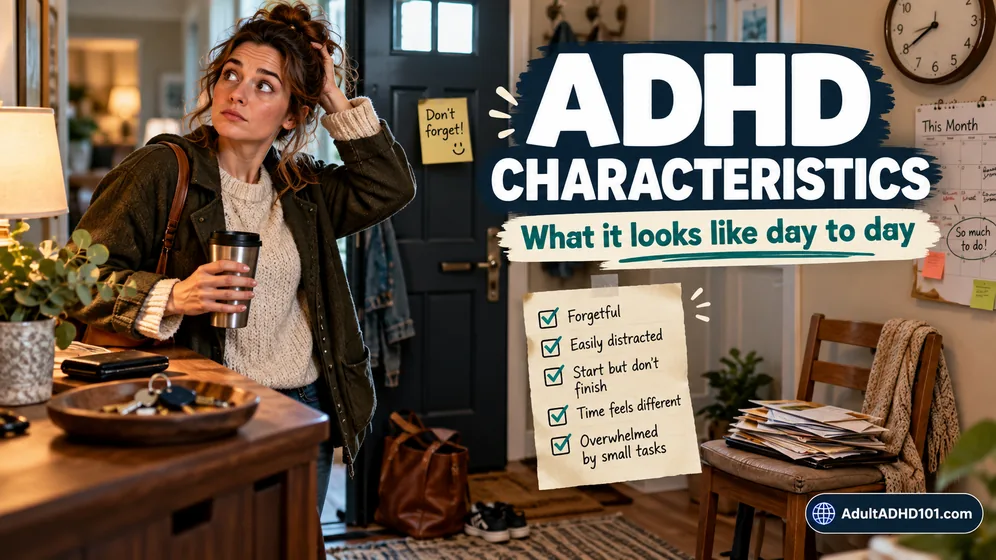
ADHD characteristics can look like ordinary gaps between intention and action. People may notice trouble starting, stopping, tracking time, holding details, managing energy or slowing a reaction. This is not a checklist you can score. It is not a way to work out whether you have ADHD.
What People Usually Notice First
The visible moment is often small. A simple email stays open all afternoon. Keys vanish in a place you already checked. A short errand grows because the needed paper is still at home.
Other people may notice lateness or unfinished work. You may notice the effort behind it. Knowing what to do is not always the same as starting it. Interest, urgency and clear steps can change how reachable a task feels.
EVERYDAY LANGUAGE
Describe what happened without turning it into a verdict. “The task had no clear start” is more useful than “I am lazy.” For a broader overview, visit adult ADHD in daily life.
Starting and Finishing
Starting can stall when a task is vague, dull or made of hidden steps. “Deal with paperwork” asks you to sort, decide, find details and respond. The action is hard to see inside the label.
Name a physical starting action. Open the envelope. Find the account page. Write the subject line. A visible action gives attention somewhere to land without pretending the whole task is easy.
Finishing has its own friction. The interesting part may be over while checking, filing or sending remains. Keep the finish visible beside the main task. “Draft reply” and “send reply” are different actions.
 Replace broad projects with visible actions.
- Keep the final send, store or tidy step in view.
- Leave a restart note before you stop.
Want the short version? The 7-Day ADHD Reset Kit
Seven days, one small step each day. A printable PDF kit for adults who want their week to feel less like a fight.
PRINTABLE PDF KIT · LIMITED TIME OFFER
Time and Memory
A task may feel far away until it suddenly feels late. The clock is available, but passing time does not stay in view. Transitions then get squeezed, especially when the current task is absorbing.
Memory can work the same way. An intention feels clear in the kitchen and disappears at the desk. Put the reminder where the action will happen. A note beside the bag can work better than a thought you must recall later.
Use calendars for commitments and visible cues for transitions. Add the preparation that happens before leaving. The time blindness guide explores practical ways to make time easier to notice.
Energy and Rest
Energy may not match the size of the task. A busy project can feel easier than a small form. Novel work may pull you in, while repeat admin remains untouched even when it matters.
Deep attention can also make stopping difficult. You may keep going past food, rest or another commitment because the shift feels costly. Stopping is a task too. A visible end cue can protect the next part of your day.
Plan demanding work around the energy you commonly have, not the energy you hope appears. Keep lighter admin ready for lower-energy periods. More flexible planning ideas live in ADHD productivity.
Emotions and Reactions
A change, criticism or blocked plan can bring a fast reaction. The feeling may arrive before you have words for it. That can make a message or meeting feel larger in the moment.
A pause creates room between feeling and action. Save the draft. Step away from the screen. Write the plain facts before writing your reply. You can take the feeling seriously without acting at its speed.
Afterward, notice what raised the load. Hunger, noise, rushed transitions or several open tasks may have made the moment harder. The emotional regulation guide stays with this everyday skill layer.
Why This Is Not a Checklist
Many people sometimes lose keys, delay dull work or react quickly. Context matters. Stress, workload and poor systems can change everyday behaviour. A list on a web page cannot explain your personal experience.
Do not add up these examples or score yourself. They are descriptions for clearer conversations and better organization. They cannot tell you whether you have ADHD or what personal support fits you.
If you want general background, start with ADHD basics. If you want practical support categories, read ADHD help for adults.
Sources for the general information on this page: CDC (cdc.gov), NIH/NIMH (nimh.nih.gov), Mayo Clinic (mayoclinic.org). Educational information only, not medical advice.