A practical ADHD productivity plan has three priorities, gives every time estimate a ×1.5 correction, and ends with a 10-minute shutdown. Everything else stays on a separate parking list.
Turn 23 tasks into a Big 3 Day
A brain dump is useful for capture, but it is too crowded to run your day. The Big 3 Day separates collecting from choosing.
Imagine your brain dump contains 23 items: send a proposal, pay the power bill, book a dentist appointment, buy groceries, submit expenses, return two calls, wash towels, replace a light bulb, order printer ink, and 14 other tasks. Move that page out of sight before choosing.
On a fresh page, ask: “What would make today feel steady if only this got done?” In this example, the answer produces these three priorities:
- Send the proposal by 10:30 a.m. Done means the PDF is attached and the email is sent.
- Pay the power bill due today. Done means the confirmation number is saved.
- Collect the grocery order before 6:00 p.m. Done means the bags are home.
BIG 3 TEMPLATE ROW
Priority: Send proposal | Done means: Email sent with PDF | Corrected time: 90 minutes | Deadline: 10:30 a.m.
The other 20 items go on a separate parking list. Keep that list closed while you order or work through the Big 3. New requests also go to the parking list unless they change a fixed deadline today.
Your day list contains three priorities. Your parking list stores everything that is not part of today’s commitment.
Correct estimates with the ×1.5 rule
Before scheduling an open-ended task, write your first estimate and multiply it by 1.5. A 30-minute estimate becomes 45 minutes. A 60-minute estimate becomes 90 minutes.
| Task | First estimate | ×1.5 plan | What happened |
|---|---|---|---|
| Reply to three emails | 10 minutes | 15 minutes | 14 minutes |
| Complete expense report | 30 minutes | 45 minutes | 42 minutes |
| Draft two-page proposal | 60 minutes | 90 minutes | 95 minutes |
| Collect grocery order | 20 minutes | 30 minutes | 28 minutes |
| Fold and put away laundry | 15 minutes | 23 minutes | 25 minutes |
Round fractions up to the next whole minute. The laundry calculation is 15 × 1.5 = 22.5, so the plan uses 23 minutes.
The estimate is a starting point. The correction is the skill. After three similar tasks, use the recorded average before applying any further correction. Visit Time Blindness for more ways to compare planned and actual time.
Build a worked morning from 7:00 to 11:00
Put fixed events on the page first. Then place corrected task blocks around them. Here is a morning with an 8:30 a.m. call and a 10:30 a.m. proposal deadline:
- 7:00 to 7:30: Breakfast and medication-free personal morning tasks. Stop at 7:30.
- 7:30 to 7:45: Pay the power bill. The first estimate was 10 minutes, so the scheduled block is 15 minutes. It takes 12.
- 7:45 to 8:30: Shower, dress, and set up for the call. The first estimate was 30 minutes, corrected to 45.
- 8:30 to 9:00: Attend the fixed call.
- 9:00 to 10:30: Draft and prepare the proposal. The first estimate was 60 minutes, corrected to 90.
- 10:30 to 10:35: Finish the final check and send. The task takes 95 minutes, which becomes the reference for the next proposal.
- 10:35 to 10:45: Take a planned ten-minute break.
- 10:45 to 11:00: Record the three actual times and check the parking list once.
The five-minute proposal overrun does not require rebuilding the morning. The planned break absorbs it, and the actual time improves the next plan.
Put the system on paper
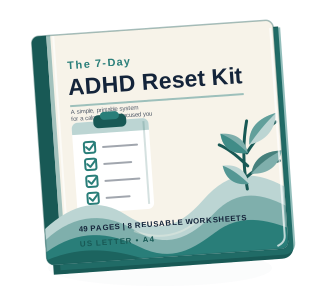
The 7-Day ADHD Reset Kit is a 49-page printable with eight worksheets, including the Brain-Dump Catcher, Big 3 Day, Time-Blindness Map, and Shutdown Shield. Complete one small task per day for seven days, about 15 minutes a day.
LIMITED TIME OFFER · $9.99, REGULAR $19
Get the Kit: $9.99Close work with a 10-Minute Shutdown
Set one timer at the same transition each day. For example, start at 5:20 p.m. and finish at 5:30 p.m.
- Minutes 0 to 3: Capture every unfinished task, promised reply, and waiting item on one page.
- Minutes 3 to 7: Write tomorrow’s opening action. Example: “Open the proposal file and check the client’s three comments.”
- Minutes 7 to 10: Close tabs, place papers together, and put the Big 3 page where you will see it tomorrow.
IF YOU SKIP IT FOR A WEEK
Do one shutdown today. Do not recreate the six missed shutdowns. Capture what is open now, choose tomorrow’s opening action, and close.
A shutdown is complete when the timer ends. It is not an extra work block.
Recover after a lost day
If the original plan is no longer possible, use a 15-minute recovery instead of trying to complete all three priorities.
- Take 3 minutes: Check today’s remaining fixed commitments.
- Take 10 minutes: Complete one useful finish. Pay the bill, send the short reply, or schedule the appointment.
- Take 2 minutes: Move unfinished Big 3 items to specific slots tomorrow or return them to the parking list.
Example: At 4:40 p.m., you cannot finish a 90-minute proposal. Spend 10 minutes collecting its source files into one folder, then schedule a corrected 90-minute block for 9:00 a.m.
Recovery means making one honest decision about what still fits. For a repeatable daily frame, use ADHD routines.