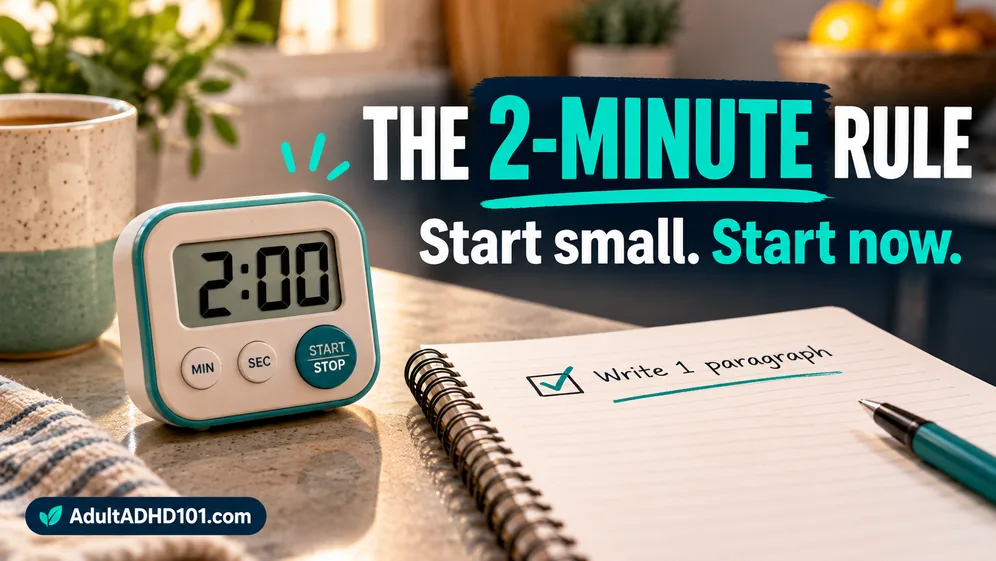
The two minute rule for ADHD is simple. If a task takes under two minutes, do it now. If it takes longer, shrink the first step until it fits.
What the Two Minute Rule Means
You see a cup on your desk. Carrying it to the sink takes little time. The rule removes the need to plan, remember, or revisit that tiny job.
A larger task needs a different approach. You do not finish the whole thing. You choose a first action that fits into two minutes. Open the document. Put the laundry basket by the washer. Find the bill.
THE RULE IN ONE LINE
Do a tiny task now. For a bigger task, make the starting action tiny.
Why Starting Can Feel So Hard
The task may look clear from the outside. Inside your head, it can feel like a pile of choices. You must remember the steps, pick an order, and decide where to begin.
This creates the familiar wall of “Where do I even begin?” Working memory can also lose the next step. A vague task then feels larger each time you look at it.
The two minute rule lowers that wall. It turns “clean the kitchen” into “put one cup away.” The goal is not speed. The goal is a clear point of entry.
Want the short version? The 7-Day ADHD Reset Kit
Seven days, one small step each day. A printable PDF kit for adults who want their week to feel less like a fight.
PRINTABLE PDF KIT · LIMITED TIME OFFER
How to Shrink a Task
Start with the task you keep avoiding. Ignore the finished result for now. Ask what your hands must do first. The answer should be visible and specific.
 Name the first physical action. Open the laptop, pick up the bag, or place the paper on your desk.
- Set a two minute timer. Work only on that first action while it runs.
- Stop when it rings. Then choose whether to continue or leave the next step ready.
“Work on the report” is still too wide. “Open the report and read the last line” is smaller. “Sort the closet” can become “place one empty bag by the door.”
Stopping is allowed. That promise makes starting safer. If you continue, treat the extra work as a choice. You have already completed the rule.
Where the Rule Helps and Where It Fails
The rule works well for small loose ends. Try it with dishes, short replies, simple filing, or setting out tomorrow’s clothes. It also helps create a start for work that feels unclear.
It works less well when the task needs deep thought. It can also fail when every small job pulls you away. Constant switching may leave your main work untouched.
Use small actions with clear edges. Save random loose ends for a planned break. If a task brings serious money, legal, or safety risks, slow down and get suitable help.
Useful Variations of the Rule
Try the reverse two minute rule. Start a task, then stop on purpose when the timer rings. Leave the next action visible. This builds trust that starting does not trap you.
You can also pair the rule with a short visual list. Write only a few first actions. Keep each line physical and clear. Cross one off before choosing another.
A visual list protects working memory. You do not need to hold every step in your head. For more support, explore ADHD productivity, executive function, and ADHD printables.
Keep the rule light. It is a starting tool, not a demand to finish everything. Pick one physical action, begin, and decide again when the timer ends.
Sources for the general information on this page: CDC (cdc.gov), NIH/NIMH (nimh.nih.gov), Mayo Clinic (mayoclinic.org). Educational information only, not medical advice.