Executive function and ADHD often show up in five everyday skills: initiation, working memory, planning and sequencing, time awareness, and task switching. Use a different external support for each skill.
Match the problem to one of five skills
Do not rebuild your entire system when one part of a task stalls. Name the skill involved and apply its short practice.
| Skill | What failure can look like | External support | Time |
|---|---|---|---|
| Initiation | The report is open, but no work begins. | Write one verb phrase, such as “Open Q2 notes,” then do only the first 60 seconds. | 2 minutes |
| Working memory | A number or instruction disappears after changing tabs. | Use one visible holding page for the task and write three needed facts on it. | 90 seconds |
| Planning and sequencing | You work on step four before step one is ready. | Write four actions on separate lines and number them 1 through 4. | 3 minutes |
| Time awareness | A task fills a gap that was meant to hold several tasks. | Mark fixed anchors, then multiply each gap-task estimate by 1.5. | 5 minutes |
| Task switching | You stop suddenly and cannot find your place later. | Write a two-line bridge before standing up: where I stopped and next action. | 45 seconds |
Test one row for three workdays before changing it. The goal is to support the exact skill involved, not add five new habits at once.
Practice initiation and working memory separately
Initiation is about beginning. Working memory is about holding useful information while you continue. Give each one its own piece of paper.
INITIATION PRACTICE
Opening move: Open the client email.
First 60 seconds: Copy the three questions into the reply box.
Stop point: After 60 seconds, choose whether to continue for five more minutes.
Use a verb phrase with one object. “Open the client email” works. “Sort out the client situation” still contains several decisions.
For working memory, place one holding page beside the keyboard. Give it three labeled lines:
 Using now: Client requested dates for April 8, 10, and 12.
- Waiting for: Sam to confirm the room.
- Check before sending: Attachment, price, and deadline.
Keep one visible holding page per active task. Put every fact needed for that task on the page instead of trying to carry it between tabs.
If 60 seconds is still too large, the two-minute rule gives you another timed starting format.
Turn planning into a numbered sequence
A project name does not show order. Convert it into three to five actions that can be completed in sequence.
For an expense report, a four-action sequence could be:
- Gather: Put six receipts beside the laptop.
- Enter: Add the six dates and amounts to the form.
- Check: Compare the total with the card statement.
- Send: Attach the receipt file and submit the form.
Number the actions before beginning. If a missing item blocks step two, write “request missing hotel receipt” on the holding page and continue only if another numbered action remains possible.
10-MINUTE WEEKLY RESET
Once a week: 1) empty capture notes, 2) scan the next seven calendar days, 3) mark deadlines, 4) choose three weekly outcomes, 5) sequence one unclear project, and 6) prepare the first item needed. The Weekly Reset Checklist keeps all six steps on one page.
Stop when the ten-minute timer rings. Unfinished sorting can return to the next weekly reset.
Build a Time-Blindness Map around fixed anchors
Start with events that happen at set times. These are fixed anchors. Then calculate the gaps between them and place corrected task estimates inside those gaps.
Example Tuesday anchors:
- 8:30 to 9:00 a.m.: Team call
- 12:00 to 12:30 p.m.: Lunch
- 3:00 to 3:30 p.m.: Client call
- 5:30 p.m.: Leave for grocery pickup
The 9:00 a.m. to noon gap contains 180 minutes. A report estimated at 60 minutes becomes 90 minutes. Email estimated at 30 minutes becomes 45. Filing estimated at 10 minutes becomes 15. The corrected tasks use 150 minutes, leaving 30 minutes for a break and transition.
TIME-BLINDNESS MAP ROW
Gap: 9:00 a.m. to noon, 180 minutes | Corrected tasks: 90 + 45 + 15 = 150 minutes | Unassigned: 30 minutes
Fill fixed anchors first. Do not schedule more corrected task time than the gap contains.
Write a two-line bridge before switching
Use the final 45 seconds of a work block to record two lines before you stand up or open the next task.
TWO-LINE BRIDGE
Where I stopped: Invoice rows 1 through 12 match the statement.
Next action: Open the March statement and match row 13.
Write the bridge in the document, on a sticky note, or on the task’s holding page. Keep the two labels the same every time.
- At 10:28: Stop adding new work.
- At 10:29: Write the two bridge lines.
- At 10:30: Close the file and move to the scheduled task.
If you switch tasks six times, you should finish the day with no more than six bridges. Delete each bridge after using it.
Practice one executive function skill each day
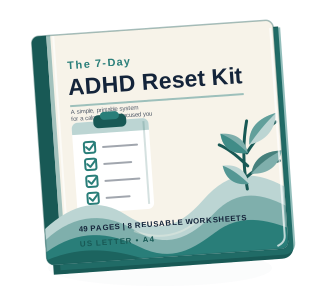
The 7-Day ADHD Reset Kit has 49 printable pages and eight worksheets, including the Task Igniter, Time-Blindness Map, Shutdown Shield, and Weekly Reset Checklist. Complete one small task per day for seven days, about 15 minutes a day.
LIMITED TIME OFFER · $9.99, REGULAR $19
Get the Kit: $9.99