Separate what happened from who you are. Name the missed task, narrow the open loops, and choose one small repair. You do not need to judge your whole day to decide the next useful action.
What people mean by masking
Adults often use “masking” to describe the effort of appearing steady. You may hold in movement, rehearse small talk or prepare far more than the moment needs. The goal is often simple: avoid standing out.
From outside, that effort can look like ease. Inside, you are tracking your face, words, timing and surroundings. The hidden work still uses energy. That matters when you plan the rest of your day.
 Notice which settings require the most performance.
- Leave fewer choices for the time after them.
- Plan a quiet transition instead of another demand.
This is a description of a common experience, not a test or label. The practical point is to count the effort when deciding what comes next.
Try leaving a small gap after a demanding setting. Put fewer tasks in that space. Keep food, keys and tomorrow’s notes easy to find. A gentler transition is practical planning, not a reward you must earn.
Separate the missed thing from yourself
You meant to reply, pay the bill or start the task. The gap between intent and action can quickly become a story about your character. That story costs more attention without fixing the missed thing.
Name the event in plain words. “I missed the reply” is specific. “I ruin everything” is broad and gives you nothing to do. A useful next sentence is: “The repair is to send a short answer now.”
KEEP IT SPECIFIC
The action failed. That does not make you a failure. Describe the task, choose the repair, and stop the verdict. The restart rule in ADHD routines can help after a missed day.
Give overwhelm a visible shape
Overwhelm often feels like one solid block. On paper, it may be many open loops with no clear next step. Messages, laundry, forms and unfinished work all compete at once.
Do not organise the whole pile first. Write every open loop in short words. Circle the one that will reduce the most friction. Then turn it into a physical action.
- Empty the loops. Put each concern on paper without sorting it.
- Choose one repair. Pick what will make the next part easier.
- Write the action. Use a verb you can see yourself doing.
Clarity comes before motivation. If choosing still feels hard, learn how to expose the next step in the executive function hub.
Keep the uncircled loops on the page. You are not ignoring them. You are giving them a place to wait while one action gets your full attention. Return to the list only after that action is done or clearly parked.
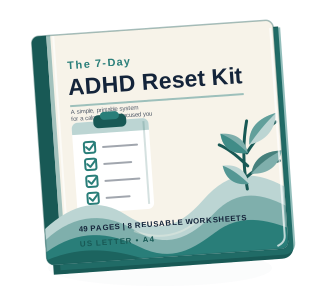
Want the short version? The 7-Day ADHD Reset Kit
Seven days, one small step each day. A printable PDF kit for adults who want their week to feel less like a fight.
PRINTABLE PDF KIT · LIMITED TIME OFFER
Reset after a day that went sideways
A reset is not a plan to catch up on everything. Start by naming what actually happened. Perhaps the task was unclear, the day changed, or too many choices stayed open.
Pick one small repair. Send the message. Put the paper by the door. Write tomorrow’s first action. Then stop. A repair can be complete without clearing the whole backlog.
Leave a visible restart point for tomorrow and close the list. If attention is the main barrier, the ADHD focus hub offers simple ways to reduce noise around the next task.
Sources for the general information on this page: CDC (cdc.gov), NIH/NIMH (nimh.nih.gov), Mayo Clinic (mayoclinic.org). Educational information only, not medical advice.