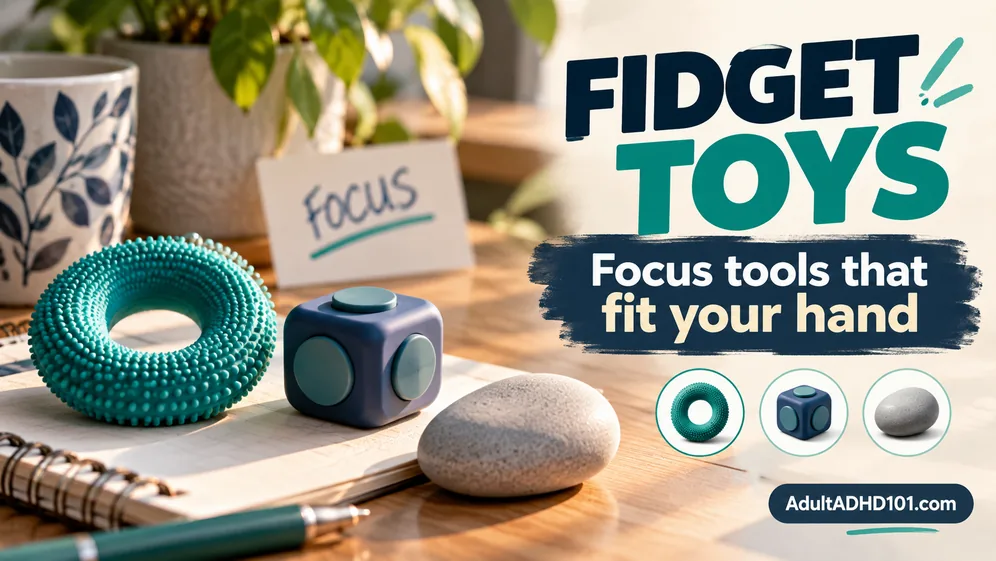
A fidget tool is a small object or movement used to keep the hands occupied. At a desk, it can offer a low-stakes anchor, a place for restless motion or a simple cue to return attention.
What a Fidget Tool Is
A fidget tool gives repetitive movement a defined place. You might roll, squeeze, bend, rub or turn it. The action should require little thought and leave your eyes available for the main task.
The object is not the point. The job it performs matters more. A smooth stone, a loop of cord or a soft piece of fabric can fill the same role as an item sold as a fidget toy.
A BACKGROUND TOOL
The best fidget often feels slightly boring. It gives the hands enough to do while the meeting, reading or desk task stays in front.
Fidgeting does not need to look playful. Quiet foot movement, changing posture or holding a textured object can all create a small physical anchor.
Why People Keep One on the Desk
Restless hands often find their own task. They tap a pen, pick at paper or reach for a phone. A chosen tool can give that motion a quieter, safer destination.
Some people use movement as a return cue. When the hand finds the object, it prompts a quick check: am I still with the task? In that sense, the tool acts like a physical bookmark for attention.
 Give restless hands a repeatable movement.
- Use the object as a cue to look back at the current task.
- Mark a natural pause without opening another screen.
A fidget can also work as a self-timer without using a clock. You might handle it while reading a page, then put it down when you reach a clear stopping point. The task defines the interval.
Want the short version? The 7-Day ADHD Reset Kit
Seven days, one small step each day. A printable PDF kit for adults who want their week to feel less like a fight.
PRINTABLE PDF KIT · LIMITED TIME OFFER
What to Look For
Begin with the setting, not a catalog. A shared office calls for quiet movement. A video call may need something that stays below the camera. Reading may work better with a tool that does not pull your eyes away.
Choose a motion that feels easy to repeat. The object should be comfortable, sturdy and simple to set down. Low visual interest is often useful because the main task should remain more important.
| Need | Look for | Avoid |
|---|---|---|
| Shared space | Quiet, contained movement | Clicks, rattles or rolling parts |
| Reading | Touch without watching | Detailed puzzles |
| Calls | One-handed use | Large arm movements |
| Desk work | Easy pickup and put-down | Loose pieces |
Think about cleanup too. A desk tool should have a clear home. If it spreads, leaks, stains or scatters, managing it may create more work than the movement removes.
The ADHD apps and tools hub covers the same principle: pick a tool for a specific job, not because it promises to fix everything.
When It Becomes a Distraction
A fidget has crossed the line when you watch it more than the work. The same is true if you keep changing patterns, chasing a trick or thinking about the object after putting it down.
Noise is another signal. If nearby people notice every movement, the tool may be adding friction to the room. Useful motion should stay in the background.
- Pause the tool. Put it in a drawer and return to one visible task.
- Name the pull. Decide whether sound, novelty or complexity took over.
- Simplify the motion. Try a quieter object or plain hand movement.
- Change the setting. Keep different options for private and shared spaces.
If the object repeatedly becomes the task, remove it. Try a clearer work block from ADHD focus or a visible next action from executive function.
Low-Cost Alternatives
You may already own a useful option. A smooth pebble, elastic loop, folded fabric, paper clip chain or silent pen can provide simple movement. Check for sharp edges and loose parts before using anything repeatedly.
You can also fidget without an object. Press your feet into the floor, trace a thumb across your fingertips or shift between seated positions. No purchase is required.
TEST THE JOB
Use one ordinary object during a familiar desk task. Keep it only if the task stays central and the movement remains quiet.
Store the chosen item beside the task it supports. A reading tool can live near your notebook. A call tool can stay beside your headset. This makes it part of the workspace, not another object to hunt for.
For more practical setup ideas, browse ADHD at work and ADHD routines.